Quiet Luxury at Home: Why Matching Nightwear Sets Are a Wardrobe EssentialA wardrobe can feel considered without being large. At home, that may mean a few garments whose colours work together, whose fabrics feel pleasant and whose proportions suit the wearer. Quiet luxury describes this restrained styling approach more usefully than it describes a particular price bracket or a visible brand name.
The idea does not require replacing every familiar piece. It begins with noticing what is worn repeatedly and why. An elegant garment that demands inconvenient care may remain untouched, while a simpler one becomes part of most evenings. A successful home wardrobe brings appearance and routine into the same decision.
Why Coordinated Nightwear Creates an Effortless Look
Matching pieces remove some of the small decisions involved in getting dressed. A shared colour gives the eye a continuous line, while complementary fabrics prevent the layers from seeming unrelated. Coordination can also come from a repeated trim or a similar softness of shape, even when the two garments are not identical. A shared mood can be enough to connect them.
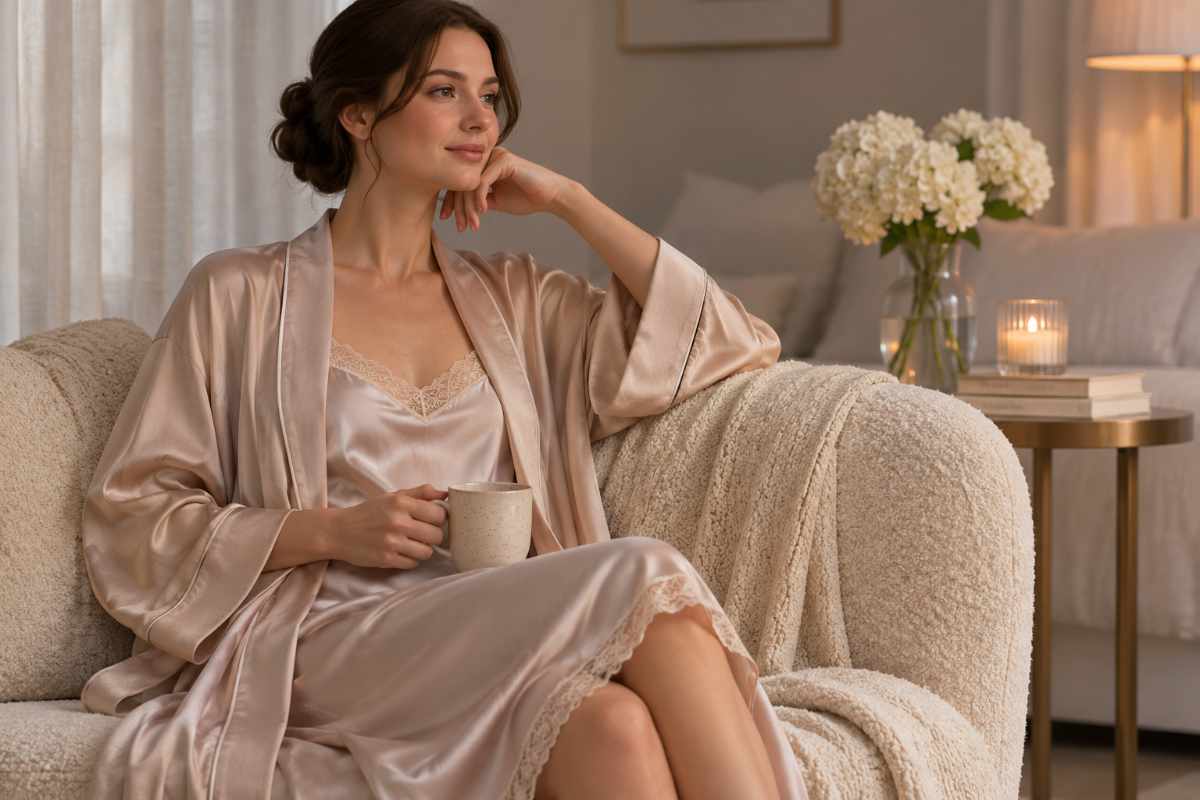
Proportion is just as important. A voluminous robe may work best over a relatively simple nightgown, allowing the outer layer to move without competing gathers underneath. Similar hem lengths create continuity; a shorter inner layer gives the robe a framing role. The result feels deliberate when the relationship is clear, rather than when every surface carries the same decoration.
Building a Refined At-Home Wardrobe Around Matching Pieces
Planning around actual occasions helps keep a collection manageable. Reading before bed, having breakfast and packing for a short trip do not necessarily require separate outfits. A small wardrobe can cover these moments through suitable layers, with enough rotation to allow garments to be washed and dried properly.
The Role of a Matching Robe and Nightgown
A robe and nightgown set connects a close-to-body garment with a removable outer layer. The nightgown can remain light, while the robe supplies additional coverage during the hours around sleep. That relationship is useful only if both pieces work independently as well as together.
Packing provides a practical way to test the value of the combination:
- the nightgown occupies little space without needing a separate top;
- the robe supplies coverage in a shared holiday apartment;
- related colours work with one simple pair of indoor shoes;
- the two care requirements fit the length of the trip.
Delicate pieces may still need careful folding and protection from luggage hardware. A coordinated outfit simplifies styling, but it does not remove the need to consider the journey or destination.
At home, the same approach can identify genuine gaps. If a favourite nightgown already works well, a compatible robe may be more useful than another complete outfit. If existing pieces have awkwardly different lengths or care needs, a coordinated pair may resolve the mismatch. Wardrobe planning starts with those small observations, keeping the emphasis on repeated use instead of an idealised image of how every evening ought to look. Storage space deserves consideration as well.
Colours, Textures and Cuts That Create Understated Elegance
Neutral colours are a useful starting point, not an obligation. Cream, soft grey and deep navy can create a restrained impression, but a muted green or dusty rose can be equally quiet. The important question is how much contrast the combination introduces and whether it suits the wearer's existing preferences.
Texture keeps simple colour schemes from looking flat. A smooth nightgown under a lightly textured robe creates interest without a busy pattern. A small lace edge can have the same effect, provided it does not compete with elaborate sleeves or a heavily decorated neckline. Even the width of a sash changes the emphasis: a narrow tie blends into the garment, while a broad one marks the waist more strongly.
Choosing Pieces That Suit Your Everyday Routine
Wearability becomes clearer when the outfit is considered in the setting where it will spend most of its time. A few practical questions can prevent an attractive purchase from becoming an occasional prop:
- whether the hem clears stairs and ordinary indoor footwear;
- whether sleeves stay clear during breakfast or evening tasks;
- whether the neckline remains comfortable when sitting back;
- whether the washing and drying requirements suit regular use.
These details determine how readily the garments enter everyday life. They also help distinguish a useful addition from another version of something already left unworn.
Matching nightwear is not an essential purchase for every person, despite the language often attached to it. Its strongest claim to a place in the wardrobe is simpler: it offers a ready relationship between pieces that the wearer likes and uses. Restraint then becomes a practical habit, expressed through a small number of compatible garments rather than a constant search for something new.