From multi-step routines and ingredient layering to serums for almost every conceivable skin concern, skincare has become increasingly sophisticated. But are we reaching the point where many of us simply want our routines to be simpler again?
For years, the beauty industry has encouraged us to add another step.
Cleanser. Toner. Essence. Serum. Eye cream. Moisturiser. Face oil. SPF.
Add exfoliating acids, retinoids, vitamin C, peptides and the latest trending active ingredient, and even a seemingly straightforward skincare routine can quickly become complicated.
Now there are signs that consumers may be reconsidering whether more really is better.
New research released by skincare brand CeraVe found that simplicity is an important consideration for many consumers when deciding whether they will actually stick with a skincare routine.
In a survey involving 6,000 adults across five European countries, 55 per cent said skincare needs to be simple or they will not maintain the routine.
It raises an interesting question: has skincare become too complicated?
How Did Skincare Become So Complicated?
Part of the change has come from our increasing knowledge of skincare ingredients.
Consumers who once shopped primarily by product type now recognise ingredients such as niacinamide, hyaluronic acid, salicylic acid, ceramides, peptides and retinol.
Social media has accelerated that education.
TikTok, Instagram and YouTube have made skincare advice extraordinarily accessible, with dermatologists, cosmetic formulators, beauty creators and enthusiastic consumers all discussing ingredients and routines.
That can be empowering.
Understanding what is inside a product makes it easier to make informed choices rather than relying entirely on packaging or advertising.
But there is another side to ingredient awareness.
Knowing about more ingredients can sometimes create the impression that we need all of them.
When More Skincare Is Not Necessarily Better
The temptation to layer multiple products becomes particularly strong when every serum promises to address a different concern.
One product targets pigmentation. Another promises hydration. Another focuses on texture. Then there is something for pores, fine lines, dullness and the skin barrier.
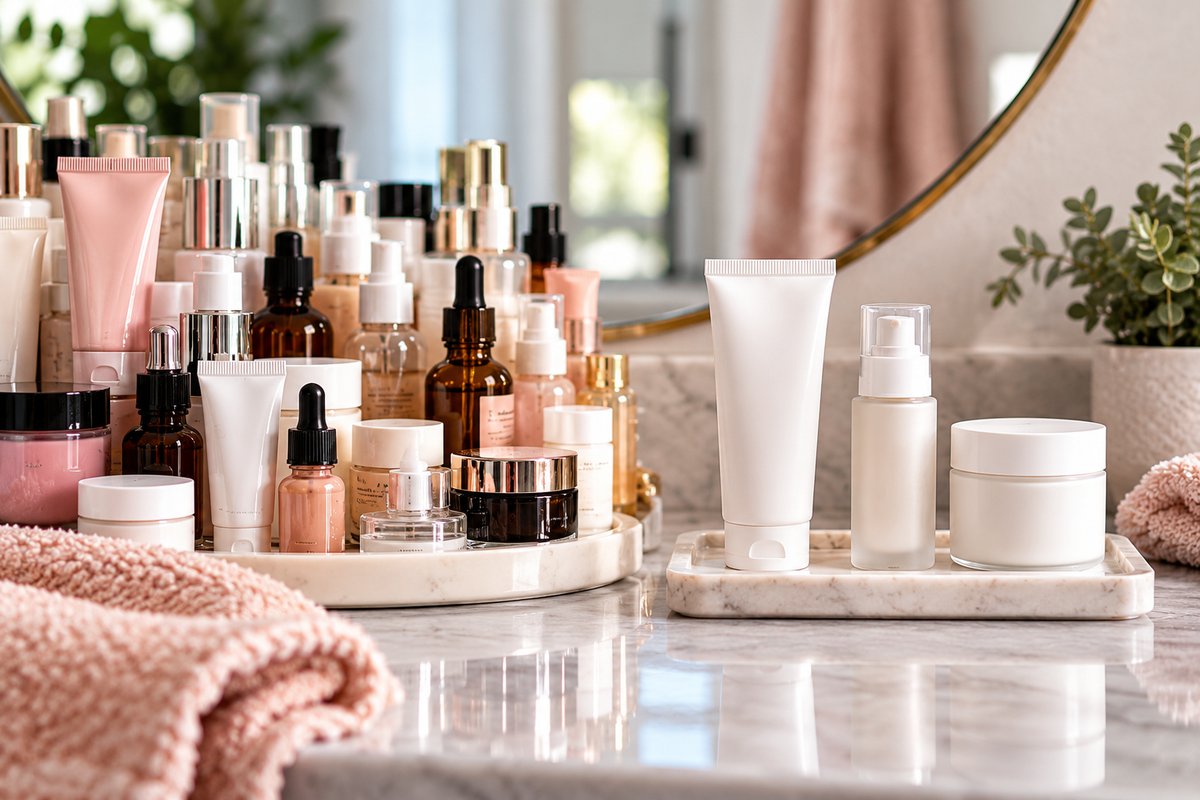
Before long, the bathroom cabinet starts looking remarkably like a chemistry laboratory.
Using multiple skincare products is not automatically a problem. But complicated routines can make it harder to understand which products are actually helping your skin.
They can also increase the likelihood of combining ingredients or products that your individual skin may not tolerate well.
Perhaps most importantly, a complicated routine that you regularly abandon may be less useful than a simple routine you can comfortably maintain.
Enter Skinimalism
The idea of simplifying beauty routines is not entirely new.
The term skinimalism has been circulating within beauty for several years, generally describing a move towards fewer products and more purposeful skincare.
Instead of constantly adding steps, the philosophy is about identifying what your skin actually needs.
That might mean a cleanser, moisturiser and daily sunscreen form the foundation, with targeted products introduced where appropriate.
It does not necessarily mean abandoning serums, treatments or active ingredients.
It means giving each product a reason to be there.
Are We Experiencing Active-Ingredient Fatigue?
The beauty industry's fascination with active ingredients has created a remarkably informed generation of skincare consumers.
It has also created plenty of confusion.
A scroll through social media can leave you wondering whether you should be using retinol, vitamin C, peptides, exfoliating acids, niacinamide and several forms of hyaluronic acid before breakfast.
Trends can move particularly quickly.
One ingredient becomes essential, another suddenly appears in hundreds of new products, and another is declared outdated before many consumers have finished their first bottle.
The result can be something resembling skincare FOMO — the feeling that if a trending ingredient is missing from your routine, your skin is somehow missing out.
But skincare does not need to follow every trend.
Your Skin Does Not Know How Many Products You Own
One of the most useful ways to approach skincare is to separate the enjoyment of beauty products from what your skin actually requires.
There is nothing wrong with enjoying an elaborate routine.
For some people, skincare is an enjoyable ritual and a form of self-care. Trying new textures, formulations and ingredients is part of the appeal.
For others, three straightforward products are more than enough.
Neither approach needs to be the universal answer.
The important question is whether the routine works for your skin, your lifestyle and your budget.
The Skin Barrier Is Having Its Moment
Interestingly, the movement towards simpler skincare is happening alongside increasing interest in the skin barrier.
Rather than focusing exclusively on correcting individual concerns, many brands are now talking about maintaining and supporting the skin's protective barrier.
CeraVe has built much of its own positioning around ceramides and barrier-supporting skincare, so its interest in simplicity is not surprising.
But the wider trend extends well beyond one brand.
Gentle cleansers, barrier creams, ceramides and products designed to reduce unnecessary irritation have become increasingly prominent across the beauty market.
After years of aggressive exfoliation and increasingly complicated routines, the pendulum may be moving towards a gentler approach.
What Does a Simple Skincare Routine Look Like?
There is no single routine that suits everyone.
Skin type, age, climate, individual concerns and medical conditions can all influence what is appropriate.
However, simplicity begins by asking what each product in your routine is actually doing.
Is your cleanser effectively cleansing without leaving your skin uncomfortable?
Does your moisturiser provide the hydration your skin needs?
Are you using appropriate sun protection?
If you use a targeted serum or treatment, can you clearly explain what concern it is addressing?
If the answer to the last question is simply, “I saw it on TikTok”, it might be worth reconsidering whether the product has earned its place on the shelf.
Simple Does Not Mean Unsophisticated
Perhaps the most interesting part of the simpler-skincare movement is that it does not necessarily represent a rejection of skincare science.
It may actually represent consumers becoming more selective.
As people become increasingly familiar with ingredients and formulations, the next stage of skincare education may be learning when we do not need another product.
The goal is no longer necessarily to own the longest routine.
It is to understand your skin well enough to choose products deliberately.
Maybe the Best Routine Is the One You Will Actually Follow
Beauty trends will continue to introduce new ingredients, formulations and technologies.
Some will be genuinely useful. Others will disappear almost as quickly as they arrived.
There will always be room for experimentation.
But CeraVe's research highlights something remarkably practical: a skincare routine only has value if people are prepared to use it consistently.
So perhaps the next big skincare trend will not involve adding another bottle to the bathroom shelf.
It might involve deciding which ones we never really needed in the first place.